Starship Troopers Review (1997) – A Bombastic, Brutal, and Razor-Sharp Satire Wrapped in Explosions, Propaganda, and Bug Guts!

Wrapping up Sci-Fi month, with a film that asks much more from us than simply laughter! Some films ask us to quietly reflect, and others ask us to emotionally unravel… this film is something else altogether… Starship Troopers! Loud. Violent. Chaotic. Absurd. Covered in alien guts and soaked in propaganda so over-the-top that you almost cannot believe what you are watching! Almost.
As we potatoes wrap up Sci-Fi month, we found ourselves revisiting Starship Troopers, a film that somehow manages to be simultaneously ridiculous, hilarious, deeply unnerving, and horrifyingly relevant nearly thirty years later. What initially appears to be a dumb action movie about conventionally attractive people shooting giant space bugs slowly reveals itself to be something much sharper, stranger, and far more intentional.
And… what a ride!
Before we begin, a gentle but important note. Starship Troopers contains graphic violence, gore, militarism, propaganda imagery, fascist themes, xenophobia, mass death, body horror, and discussions of authoritarianism. While much of the film is intentionally exaggerated and satirical, some viewers may still find the imagery or themes upsetting, especially given our current political climate. Please take care of yourselves while watching and while reading.
As always, we will do our best to avoid major spoilers, but some elements of the film will absolutely be discussed. We also want to note that we will be moving through portions of the film a bit more quickly than usual. There is a lot to unpack here, and we potatoes would like to spend a little more time discussing the themes, satire, and ideas at the heart of the story!
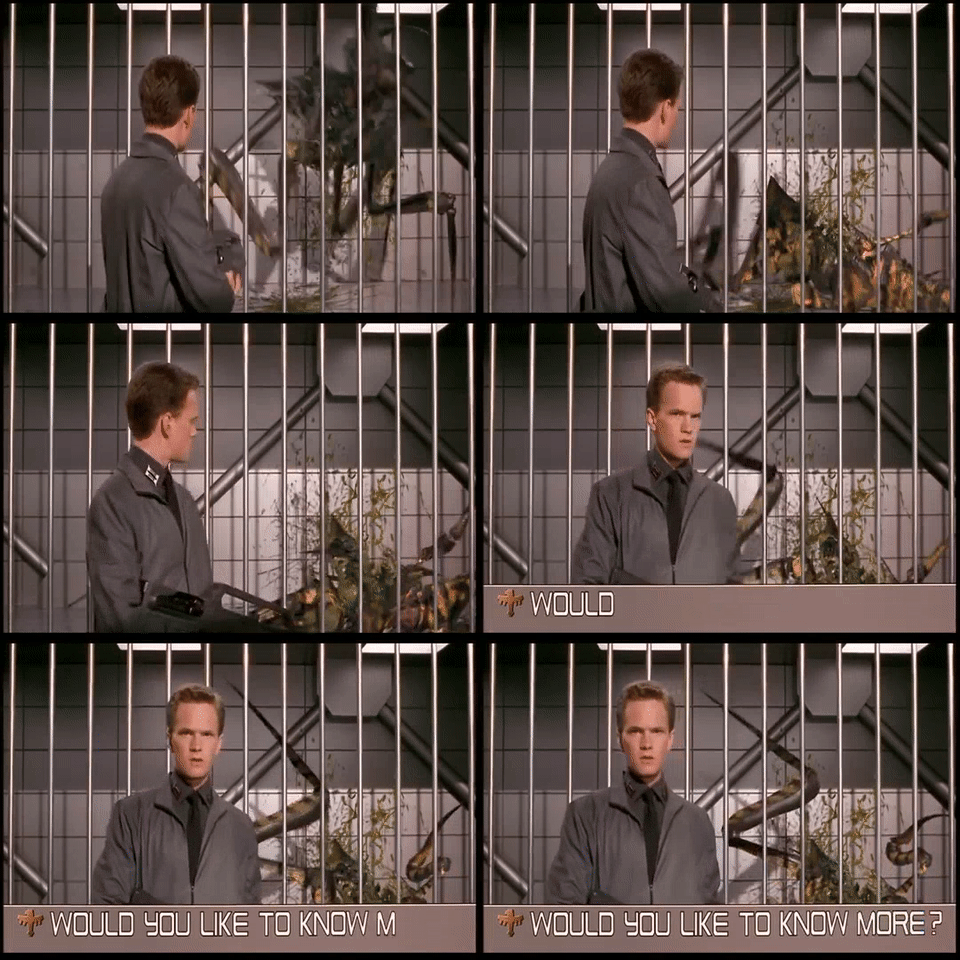
“Would you like to know more?”

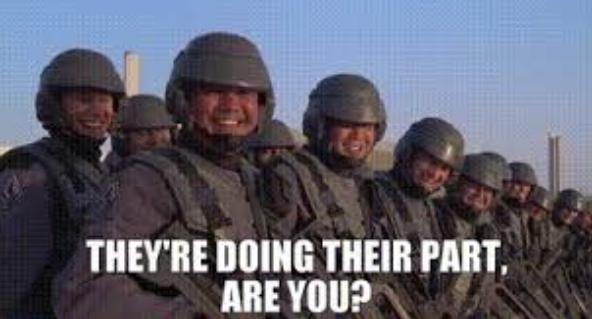
We open with one of the most iconic fake advertisements in science fiction history! “I’m doing my part!” Citizens beam proudly into the camera while military propaganda blasts across the screen with all the subtlety of a sledgehammer. Military recruitment ads frame enlistment as glamorous, heroic, and necessary. Everything is polished. Patriotic. Efficient.
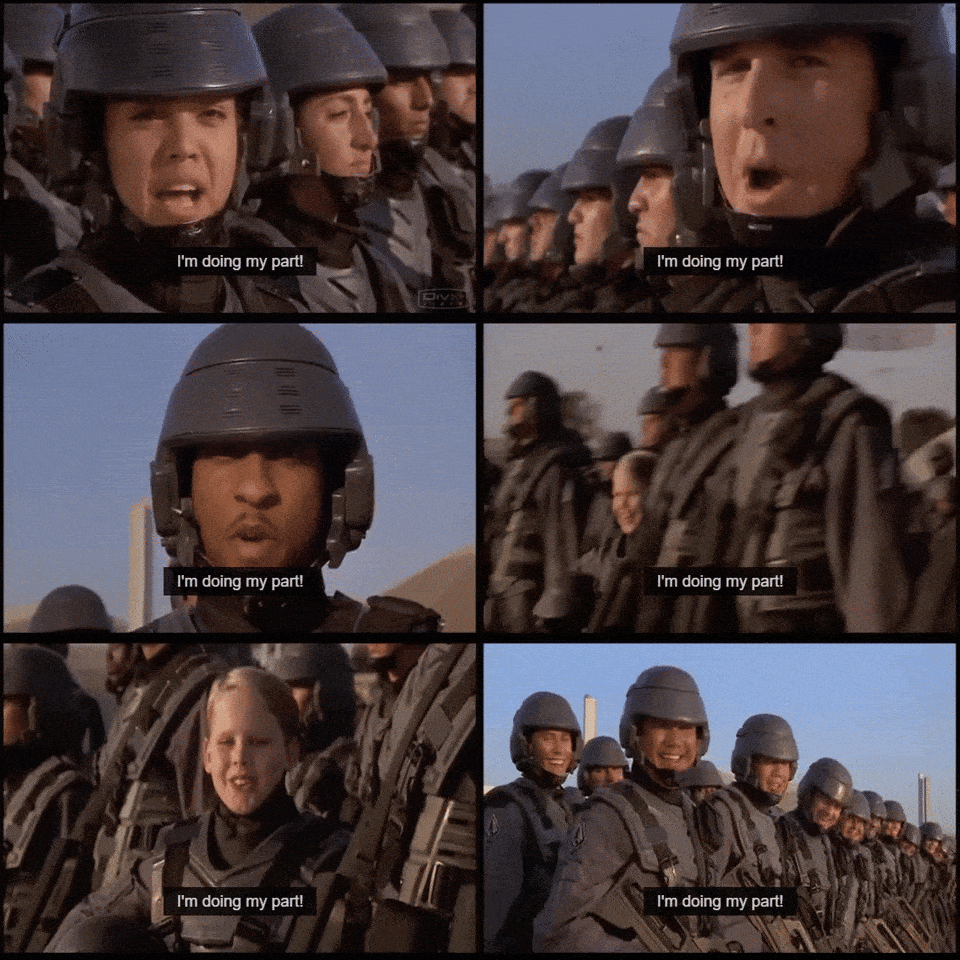
And immediately, something feels… off.
Not because the film hides what it is doing, but because it practically screams it directly into our faces while daring us not to notice.
We are then introduced to Johnny Rico (Casper Van Dien), a high school student living in Buenos Aires alongside his friends Carmen Ibanez (Denise Richards), Carl Jenkins (Neil Patrick Harris), and Dizzy Flores (Dina Meyer). They are young, energetic, and seemingly full of possibility. Their futures stretch out before them in shiny, optimistic certainty.

Well… sort of.
Because in the world of Starship Troopers, citizenship is not automatically granted. It must be earned through federal service, most commonly military service. Only citizens can vote, hold power, or fully participate in society. The message is clear from the beginning: violence and state service are framed not only as honorable, but as the very foundation of civilization itself.
Again… subtle this movie is not.
The early high school scenes are hilarious in retrospect because every classroom discussion sounds like it was written by someone who asked, “What if fascism was presented like a motivational TED Talk?” Their teacher, Jean Rasczak (Michael Ironside), delivers philosophy lessons that essentially boil down to “violence solves everything,” and the students just nod along like this is completely normal behavior.

“And force, my friends, is violence. The supreme authority from which all other authority is derived.” Gross… but ok.
And to be fair… within the world of the film, it is normal… but it made us potatoes cringe. The propaganda in this film feels eerily familiar to us.
And, that is a big part of what makes Starship Troopers so eerie and so deeply uncomfortable. Nobody twirls a cartoon villain mustache. Nobody stands around openly declaring themselves evil. The systems of this society are presented as clean, efficient, patriotic, and logical. Many of the people participating in it genuinely believe they are doing the right thing.

Sounds far too familiar to us potatoes… but we digress!
After graduation, our core cast begins moving toward adulthood! Carmen joins the fleet. Rico enlists in the Mobile Infantry largely because he is in love with Carmen. Dizzy joins the Mobile Infantry because of her fixation on Rico. Carl heads into military intelligence because he is psychic and honestly that sentence alone tells you exactly what kind of movie this is.

Dizzy, though… oh Dizzy. Sigh. She is truly one of the most frustrating parts of the entire film because she spends approximately ninety percent of the movie pursuing Rico while Rico simply does not care.
Now, before anyone comes for us potatoes, we want to be very clear. We actually like Dizzy. Dina Meyer brings warmth, confidence, competence, and genuine heart to the role. She is funny, capable, loyal, brave, and honestly one of the best soldiers in the entire film. In many ways, she is a far more compelling character than Rico himself.

Which is precisely why her storyline frustrates us so much!
Dizzy spends most of the film chasing after a man who has made his feelings abundantly clear. Rico is fixated on Carmen and not interested, while Dizzy repeatedly puts herself in situations where she is hoping he will finally notice her. It is painful to watch because she has so much more to offer than being someone's backup plan.

One of us potatoes found this particularly frustrating because it feels so familiar. How many people have been taught that persistence is romantic? That if they just keep pursuing… stay persistent enough, patient enough, and eventually the person they want will recognize what has been in front of them all along!
We see this narrative constantly in media, and while it is often presented as sweet, it really is not. It is deeply unhealthy to pursue someone who does not reciprocate, and continues to say no. Being respectful of their No and moving on is the right move… not pursuing them further.

Dizzy deserves someone who chooses her. Not someone she has to convince. Not someone she has to wait around for. Not someone she has to compete for. We potatoes spent much of the movie wanting her to realize that.
What makes it especially disappointing is that Dizzy is already remarkable. She is courageous, skilled, intelligent, and fiercely dedicated. Yet the film repeatedly centers her emotional journey around Rico's attention, as though his validation is somehow necessary for her story to feel complete. We potatoes would have loved to see her given more room to exist outside of that dynamic, or even better, to outgrow it.
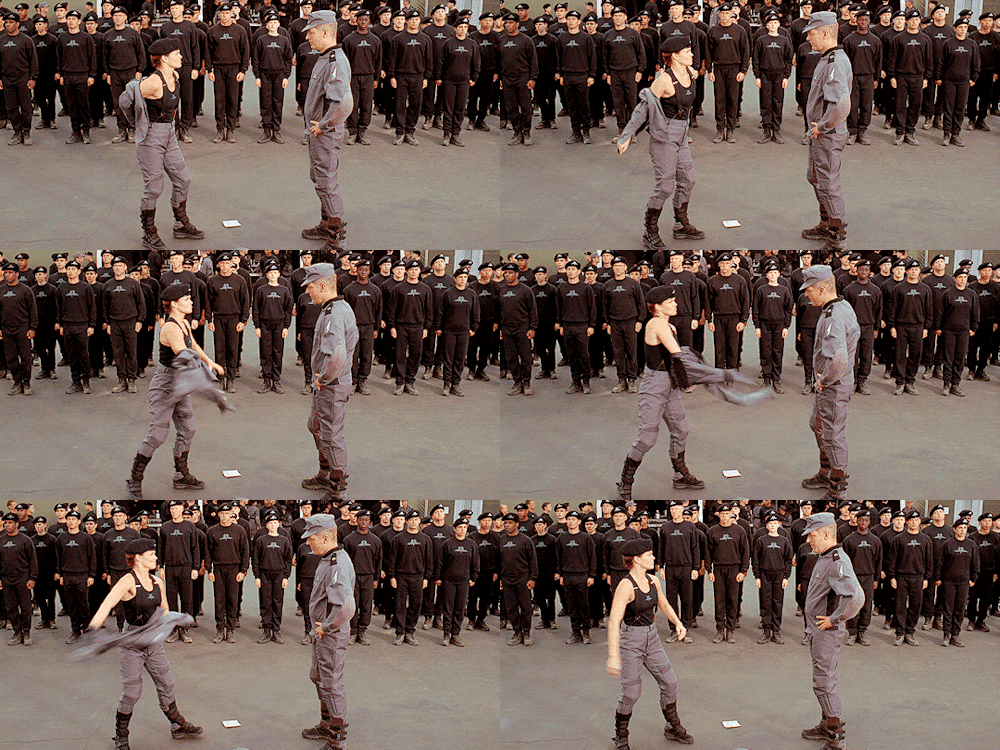
To be fair, this frustration may actually reinforce one of the film's larger themes. The Federation places enormous value on service, sacrifice, and devotion. Dizzy embodies all of those qualities, even in her personal life. She gives and gives and gives, expecting very little in return. There is something tragic about that. Her willingness to sacrifice herself emotionally mirrors the larger culture surrounding her.
Maybe that is why her story lingers with us… Not because she is weak. Not because she is foolish. But because she is so clearly worthy of more than what she settles for. Dizzy deserved better. But we digress!

Wrapping up from here! Training begins! And the film really starts flexing its muscles… literally! What initially felt playful and campy becomes increasingly brutal and disturbing. Recruits are maimed. Public humiliation is normalized. Authority is absolute. Individuality begins eroding under the pressure of conformity and nationalism.

And yet… everyone keeps smiling.
That contrast is one of the film’s smartest tricks. The performances are intentionally heightened and occasionally awkward in ways that many critics initially misunderstood. The almost soap-opera sincerity of the acting is not a flaw. It is part of the nonsense and is very purposeful. These characters speak like people raised entirely inside propaganda. Their emotional language has been flattened into recruitment slogans, patriotic certainty, and idealized heroism.

They are not just characters. They are products of their environment.
One major aspect of Starship Troopers that we potatoes found particularly chilling was its glorification of military service and the way it intertwines citizenship, morality, and personal worth. Throughout the film, military enlistment is not merely presented as a career choice or a civic duty. It is framed as the highest expression of virtue and adulthood. Service becomes the gateway to respect, belonging, political participation, and even basic personhood. Those who serve are celebrated, while those who do not are quietly treated as lesser. The speeches, slogans, and recruitment campaigns are delivered with such confidence and certainty that they begin to feel eerily familiar.

We potatoes have firsthand experience with military culture, and the language used throughout the film often sounds remarkably similar to the rhetoric used by real world institutions seeking to enforce obedience, conformity, and sacrifice for a supposedly greater cause. We potatoes still cringe at the memories of some speeches we had to hear that sounded far too close to this film. To be clear, we potatoes are not criticizing individual service members, many of whom join for complicated, systemic, and deeply personal reasons. We understand that reality all too well.

But the film does examine how institutions use patriotism, fear, belonging, and idealized notions of heroism to shape both public opinion and the people serving within those systems. Fascist movements have historically relied upon this exact dynamic. The military is elevated beyond criticism, sacrifice becomes synonymous with virtue, and questioning authority is reframed as weakness, selfishness, or even betrayal.

And perhaps nowhere is that more apparent than in the Federation's approach to citizenship itself. Which is wild… to say the least.
In the world of Starship Troopers, voting is not considered a fundamental right. It is a privilege that must be earned through service to the state. Citizenship is granted only to those who prove themselves useful to the Federation, most often through military service. The film presents this arrangement as perfectly reasonable, and that is precisely what makes it so grotesque.

The idea that only certain people deserve political participation has a long and disgusting history. Voting rights have been restricted on the basis of race, sex, class, religion, and countless other arbitrary distinctions. The justifications change, but the message remains remarkably consistent: some people deserve a voice, and others do not.
Watching Starship Troopers today, we potatoes could not help but think about ongoing attempts to restrict voting access here in the United States. The details may differ from the Federation, but the impulse feels unnervingly familiar. The desire to decide who is worthy of political participation and representation has never truly disappeared and this is not only incredibly depressing but also completely enraging.
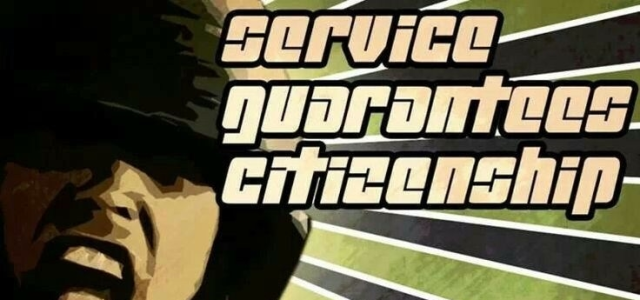
As much as Starship Troopers is an effective, funny, and disturbing satire… it is also maddening. It takes ideas that have existed throughout human history and pushes them just far enough that we can clearly see how dangerous they really are. Rights stop being rights the moment they have to be earned.
Starship Troopers does not present any of this as overt brainwashing carried out by obvious villains. Instead, it shows how these messages become normalized through repetition, culture, education, entertainment, and social pressure until they begin to feel like common sense. The propaganda works because it is wrapped in pride, identity, community, and purpose. The people participating often do not realize they are being manipulated at all.

Now, we potatoes need to talk about the bugs because wow! These creatures still absolutely rule from a design standpoint! The Arachnids are horrifying! Massive insectoid aliens that swarm, stab, slice, and overwhelm through sheer numbers. As big fans of StarCraft, we potatoes loved watching the swarm! The practical effects and CGI hold up shockingly well for the time, especially during the large-scale battle sequences.

We potatoes also have to praise the sheer craftsmanship on display here! The action sequences are massive, chaotic, and incredibly well staged. The sound design is fantastic. The creature work remains incredibly impressive. And the pacing moves at an almost relentless speed once the war truly begins.

The performances across the board fit the film perfectly! Casper Van Dien fully commits to Rico’s transformation from naive teenager to hardened soldier. Dina Meyer honestly steals the movie in many ways. Michael Ironside radiates exhausted yet self-righteous authority in every scene. Denise Richards gives Carmen more gumption and strength than we potatoes were prepared for. And Neil Patrick Harris is excellent, managing to make Carl increasingly unsettling as the film progresses.
The violence is excessive, messy, and often deeply upsetting. Limbs fly! Bodies split apart! Entire platoons are wiped out in seconds. And through all of it, the film keeps cutting back to propaganda broadcasts asking if we would like to know more. It is bleakly funny.
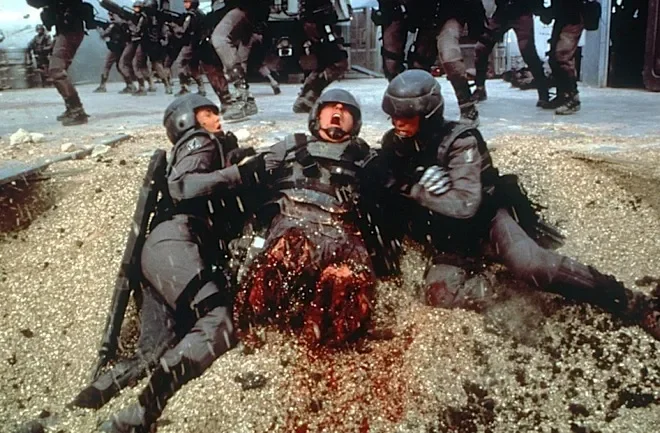
Starship Troopers is not subtle about its fascist imagery. The uniforms, the architecture, the recruitment tactics, the obsession with purity through violence, it is all there. The film intentionally places the audience in an uncomfortable position. We are cheering during scenes that should disturb us. We are entertained by systems that are fundamentally horrifying.
And the film knows we are entertained. That is the point.

The film never stops to explain the joke. It commits fully to the bit and trusts the audience to keep up. As a result, it is entirely possible to walk away thinking this is just a very enthusiastic war movie about killing alien bugs.
Which, unfortunately, many people did when it first released.
Over time, however, Starship Troopers has rightfully been reevaluated as one of the sharpest pieces of mainstream science fiction satire ever made. Beneath the spectacle is a film about militarism, nationalism, propaganda, and the terrifying ease with which societies can slide into authoritarianism while still believing themselves civilized.

Perhaps most frightening of all, the people inside these systems still fall in love. They still laugh with their friends. They still dream about the future. As we potatoes stated earlier, they are not cartoon villains twirling mustaches and plotting world domination. They are ordinary people living ordinary lives inside an abusive and unhinged system. And that may be one of the film's most disconcerting observations. Authoritarianism does not require everyone to be monsters. It only requires enough people to accept the system as normal.
Now, is Starship Troopers perfect? No. Some characters outside the main core are fairly thin, and because the film commits so hard to its satirical tone, there will absolutely be viewers who bounce off the heightened performances or mistake intentional stiffness for bad acting. Also… if you genuinely cannot tolerate gore, this movie may be an absolutely miserable experience for you. The violence is not occasional. It is constant.
But honestly? We potatoes believe the film’s commitment to its vision is exactly what makes it work so brilliantly! This is not a safe satire. It is not a quiet satire. It is a giant flashing warning sign disguised as a blockbuster action movie. And somehow… it only becomes more relevant with time.
So, is Starship Troopers subtle? Absolutely not. Is it deeply weird? Very much so. Is it one of the smartest and most viciously funny sci-fi films of the 1990s? We potatoes absolutely believe so, and we highly recommend it! If all of this sounds good to you, then this is the film for you!
It is explosive, grotesque, hilarious, horrifying, and startlingly perceptive beneath all the chaos. A film that understands spectacle so well that it weaponizes it directly against the audience and we potatoes love it!

Cheers to Dizzy Flores who deserved better! Cheers to campy science fiction that actually has something to say! Cheers to giant bug battles and deeply uncomfortable satire! And most importantly, cheers to you!
In a world overflowing with right-wing propaganda, capitalism, corruption, greed, fear, and manufactured outrage, may we all continue asking questions, thinking critically, protesting and resisting the systems that ask us to stop seeing each other as human.
We potatoes are doing our part… are you?
We give this movie 4 out of 5 June Bug cocktails!

The Starship Troopers Drinking Game
Take a sip anytime:
1. Anyone says "Bugs", "Bug", or “Arachnid”
2. Anyone says "Klendathu"
3. Anyone mentions any of the factions "Mobile Infantry", "Fleet", or "Intelligence"
4. Anyone says "Earth" or the name of a country
5. Anyone says "Invasion"
6. Anyone says “citizen”
7. Anyone gets maimed or impaled
8. Anyone dies
9. Anytime you hear, "Would you like to know more?”
10. Propaganda on screen
11. Federation, Federal, or Fed on screen
12. The main characters all meet up
13. Bugs on screen
14. Dead bodies on screen
15. Gore on screen
What do you think? Do you like the movie? Do you hate it? What movies should we watch? Do you like this drinking game? Are there rules missing? Is the game too intense? Are there movies that you think we should make a drinking game for? Let us know here in the comments and always remember to be safe and drink responsibly! (Drinks can be water, soda, anything nonalcoholic, etc. Please be safe, have fun and take care of you!)